Contents
The most powerful weapon in digital marketing is no longer mass broadcasting, but communication strategies tailored to each individual, delivered at the right time and addressing the right need. Personalization, at this exact juncture, converges with artificial intelligence (AI) to become a fundamental necessity of modern marketing. Today, brands can understand customers not merely through demographic traits, but through their habits, preferences, and behavioral patterns, establishing meaningful connections. Serving as the execution engine of this system, automation enables companies of all sizes and across all industries to execute marketing activities in real time. Consequently, investments in marketing personalization and automation are expected to grow further in the future, with personalization capabilities evolving continuously.
The Deep Analytical Power of AI in Understanding Customer Data
Going beyond traditional data collection methods, AI algorithms analyze billions of interactions within seconds, making it possible to deliver a personalized journey for every user. For instance, when a customer questions the authenticity of a purchased product, the brand can take swift action to offer a tailored solution. This minimizes customer churn risk while positively reinforcing brand perception.
Marketing focus is shifting toward predicting consumer needs before they are explicitly voiced. Delivering the right recommendation and message instantly has become the key to success. According to experts, approximately 80% of e-commerce businesses actively utilize AI-based customer insights and data analytics solutions, while 85% rely on artificial intelligence to provide personalized customer experiences. These figures demonstrate that AI-powered deep analytics is no longer merely a trend, but an essential business investment to sustain brand competitiveness. A personalized chatbot recommendation, a product list generated by a recommendation engine, or automated campaign management can make consumer interactions with a brand far more valuable. AI-driven personalization and automation are not only shaping the future of marketing but also redefining customer expectations.
Contributions of Personalization and Automation to Marketing
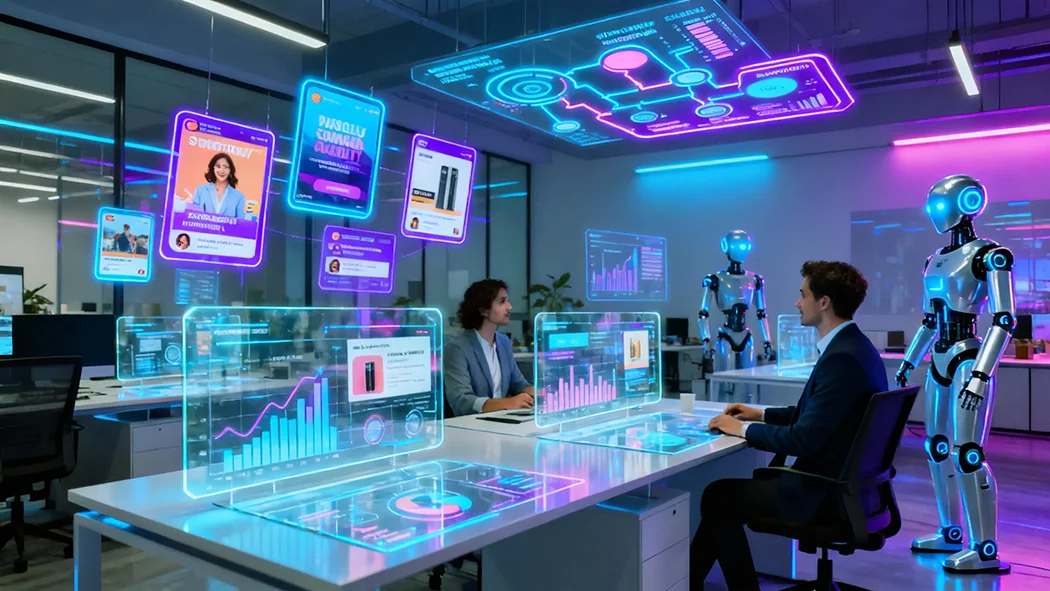
Personalization and automation redefine the speed and scale of marketing operations. Processes that once took hours can now be executed instantaneously and systematically through AI-enabled automation tools. Sending an automated reminder email when a customer abandons a shopping cart, managing distinct campaigns for different segments concurrently, or publishing social media content at optimal times is now standard practice.
Data indicates that AI-powered product recommendations can drive 20-30% of e-commerce revenue, with personalization significantly increasing conversion rates. This "hyper-personalization" encourages customers to build deeper bonds with brands, as 77% of consumers prefer brands that offer data-driven personalized experiences.
Automation brings continuity and consistency to marketing communications. For example, automated abandoned cart reminders, welcome series, and browse abandonment messages can increase open rates by 52%, click-through rates by 332%, and conversion rates by 2,361% compared to traditional campaigns. Furthermore, revenue generated from automated emails is reported to be 320% higher than manual campaigns. A similar impact is observed on social media: 47% of brands save 6-7 hours weekly using automation tools, allowing teams to focus on strategic and creative tasks.
The Importance of Personalization in Social Media, Email, and Advertising
In today's competitive landscape, generic messages fail to make an impact. Personalization across social media, email, and digital advertising aims to deliver genuine experiences by deepening brand engagement with customers. Customizing social media content based on customer interests and behaviors drives engagement, while personalized email campaigns generate substantial jumps in open and click-through rates.
In advertising, AI-powered targeting serves ads based on real-time context and behaviors rather than solely demographic traits, reducing costs while boosting conversion rates. Throughout this process, personalization strengthens brand loyalty by making consumers feel valued. Beyond functioning as a sales growth lever, it serves as the foundational key for brands to establish long-term, trust-based customer relationships.
The Near Future of Personalization with AI and Automation
Today, social media, email automation, and digital advertising interact seamlessly to drive purchasing decisions and deliver outstanding performance. With 73% of social media users expecting brand responses within 24 hours, automation satisfies this demand for speed and solidifies brand loyalty. Meanwhile, AI-driven big data platforms halve data processing times while elevating decision-making accuracy up to 95%.
With the global market volume measured at 25 billion dollars in 2023, it is projected to reach 193.7 billion dollars by 2032. In the future, advertising campaigns and customer interactions may be orchestrated almost entirely by autonomous systems. Artificial intelligence will not only handle routine workflows but also take on higher-level responsibilities, such as strategy development and campaign steering. Marketers, in turn, will transition into "AI directors," focusing on strategic guidance and oversight.
In this sweeping transformation, ethical and privacy considerations will inevitably gain prominence, evolving into specialized domains of expertise. Strategically managing these concerns to protect corporate reputation and customer trust will be a prerequisite for long-term loyalty. As customer expectations evolve, brand capabilities and proficiencies in meeting those expectations will advance in parallel. Over time, the depth of this transformation will become increasingly apparent.