
Contents
CBAM verification ceased to be a theoretical legislative topic for Turkish manufacturers as of September 2026. According to the European Commission's timetable, accredited verifiers can register with the CBAM Registry. Initial document reviews and site visits can also begin. Records for 2026 from manufacturers selling iron and steel, aluminum, cement, fertilizer, electricity, or hydrogen to the EU must now be retroactively verifiable.
The verifier will not only look at the total carbon value. They will examine the installation boundary, production route, meter records, fuels used, precursors, and calculation methodology within the same audit trail. If production, energy, procurement, and export data are maintained in disparate files, even an accurate calculation may face insufficient evidence.
This guide explains what data Turkish manufacturers must prepare before verification and how they can manage this data.
What Changed with September 2026 in CBAM Verification?
The definitive regime of CBAM began on January 1, 2026. EU importers or indirect customs representatives act under the status of authorized CBAM declarants when importing goods within the scope. The European Commission's verification calendar states that national accreditation bodies began accepting applications in April 2026.
The change in September 2026 is that the CBAM verification chain reaches the field. Accredited verifiers can register with the CBAM Registry, establish contact with the manufacturer, review documentation, and conduct site visits. The first verification reports are expected to be issued starting January 2027.
The deadline for the first annual CBAM declaration covering 2026 imports is September 30, 2027. This period may seem long. However, the report relies on actual data of goods produced during the 2026 calendar year. Reconstructing missing meter records, production volumes, or supplier emissions retroactively at year-end is not a reliable method.
The verifier's objective is to provide reasonable assurance. Implementing Regulation (EU) 2025/2546 requires an opinion stating that there is no material misstatement in the reported actual emissions. The verification report is then transmitted to the relevant declarant via the CBAM Registry.
Which Turkish Manufacturers Must Prepare?
CBAM covers specific CN codes across six sectors: iron and steel, aluminum, cement, fertilizer, electricity, and hydrogen. The commercial name of the product is not sufficient on its own. First, the product's CN code must be matched with the scope. Not every product in the same sector automatically falls under CBAM scope.
On the EU side, authorization and declaration obligations arise for importers exceeding the single mass threshold of 50 tons annually. This threshold does not cover all special circumstances such as electricity and hydrogen. The Turkish manufacturer needs to evaluate its own product code alongside its EU customer's import structure.
Türkiye's exposure is by no means negligible. According to the Ministry of Trade's transitional period review report, Türkiye was the second largest source country with 18.34 million tons out of 156 million tons of CBAM products sent to the EU. Iron and steel accounted for 69 percent of total volume.
Preliminary data from the European Commission for the first six days of 2026 also shows that 98 percent of import volume came from iron and steel. Türkiye ranked among the primary source countries in this initial window. This picture demonstrates that metal producers in particular cannot leave verification preparations solely to the environmental or sustainability team. Production, energy, quality, procurement, sales, and IT teams are all part of the same data chain.
Which Records Will the Verifier Examine?
CBAM verification is conducted at the installation level. Work begins with the installation name, English address, business registration number, CBAM Registry installation ID, UN/LOCODE information, and six-decimal geographical coordinates of the main emission source. Production processes and goods produced in these processes are then matched with CN codes.
Calculation Regulation (EU) 2025/2547 defines at least the following data groups in the monitoring plan:
- Activity level for each production process and production route
- Quantity of products and relevant precursors on a CN code basis
- Total direct emissions of the installation and distribution methodology to processes
- Quantity of fuel used, net calorific value, and emission factor
- Materials leading to process emissions and stock changes
- Electricity consumption, source, and indirect emission factor where applicable
- Imported or exported measurable heat, waste gas, and CO2 capture records if any
- Product and production data used in free allocation adjustment
The monitoring plan must also show the installation's top five products by mass, top five fuels by energy content, and top five materials by emissions. Formulas used, data sources, measurement instruments, and responsible roles must also be documented.
Precursor data creates a distinct risk in complex goods. If you procure inputs from another installation, you must attach that installation's actual emission value and, where required, its verification report to the chain. If the material code in the procurement system does not match the precursor name in the emission report, the verifier cannot trace the data seamlessly.
Why Must Data Meet in a Single Audit Trail?
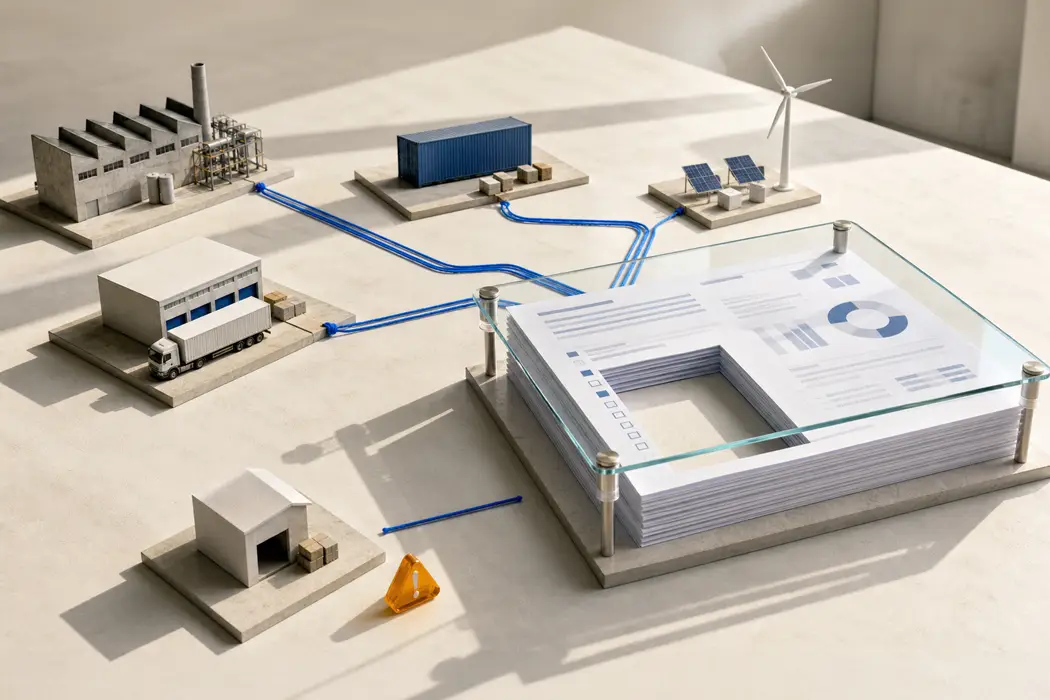
CBAM calculation is typically fed by four separate systems. ERP holds production and raw material quantities, the energy management system holds meter data, the laboratory holds fuel properties, and the foreign trade system holds CN codes and shipment quantities. Final consolidation done in Excel generates versioning and matching errors when links to source records are not preserved.
The verifier tests how data is collected alongside total emissions. Conversion steps from the meter on the production line to the final value in the report must be visible. Which file represents the final version, who modified it, and which production batches it was applied to must be recorded.
The implementing regulation establishes a 5 percent materiality level for the specific embedded emissions of goods in each CN code. This rate does not mean every discrepancy of 4.9 percent will be accepted. The verifier may consider smaller errors material based on their nature and combined effect.
A robust data architecture establishes three connections: the production order matches materials and energy used, product quantity matches the correct CN code, and shipment matches the relevant production period and emission value. API or EDI connections can transfer records across disparate systems with common keys. The real benefit of automation is not performing calculations, but keeping the source of every result reproducible.
How Can You Prepare in the First 90 Days?
In the first 30 days, determine the scope of CBAM verification and data ownership. Verify CN codes of products sold to the EU. Extract installations, production routes, and precursors in scope. Assign a system owner and business owner to each data field. The Ministry of Trade's implementation period guidance documents offer separate production and monitoring methodologies for six sectors.
In the second 30 days, a data inventory and gap analysis should be performed. List sources of all fuel, material, electricity, and production data. Reconcile meter calibrations, laboratory results, procurement records, and inventory movements for a sample month. Specially flag manually modified fields.
In the final 30 days, create a trial calculation and evidence package. Recalculate embedded emissions from end to end for a selected product and month. Test whether you can trace back from the result to the source document. Version the monitoring plan and gather documents accessible to the verifier in an access-controlled area.
A physical site visit is the baseline approach in the legislation. Virtual visits or waivers depend on specific conditions; it is not advisable for a new manufacturer to assume this. Prior to the visit, check that meters on the production site, process boundaries, and the installation diagram in the report correspond with one another.
How to Choose Between Actual Values and Default Values?
The EU importer may use Commission default values where permitted by legislation. If actual emission values are to be used, the third-country manufacturer must have total embedded emission data verified. The commercial outcome of this choice depends on the difference between the product's actual carbon intensity and default values.
For a manufacturer with lower actual emissions, verified data can provide a competitive advantage. In return, costs arise for the monitoring plan, calculation, evidence management, and verification. A manufacturer with scattered data may be unable to prove this advantage to its customer even with low emissions.
The fact that the first 2026 verification reports will be issued starting January 2027 does not mean preparation can be postponed to 2027. The report examines 2026 production data. The European Commission also requires EU importers to submit their first annual declarations by September 30, 2027.
The decision is not merely a reporting choice made by the sustainability team. Sales must evaluate the EU customer's actual value demands, finance the potential carbon cost, production the data quality, and IT the traceability together.
Final Checklist Before Verification
Do not manage CBAM preparation like writing a report. Establish links between all records feeding the same emission value, from product code to energy meter, precursor invoice to shipment record. Performing the first trial calculation on a single product and month makes data disconnections visible before year-end.
You can follow MAP's supply chain, EDI, and system integration insights on the MAP Blog. Verifiable CBAM data requires a reliable data flow before calculation spreadsheets.